
AI Reasoning is what you’re leaning on when you ask a model to compare options, follow constraints, or solve a problem with more than one step, and it’s also where many systems still stumble in surprisingly human ways.
If you’ve ever seen an assistant give a confident answer that collapses under one follow-up question, you’ve already met the core issue: generating fluent text is not the same thing as doing reliable multi-step inference. Teams care because these failures are expensive, they show up in customer-facing moments, and they can quietly break internal workflows.
This guide clears up what “reasoning” means in practice, how chain-of-thought reasoning fits in, what to test with reasoning benchmarks for AI, and how to build reasoning-augmented AI workflows that stay useful under pressure.
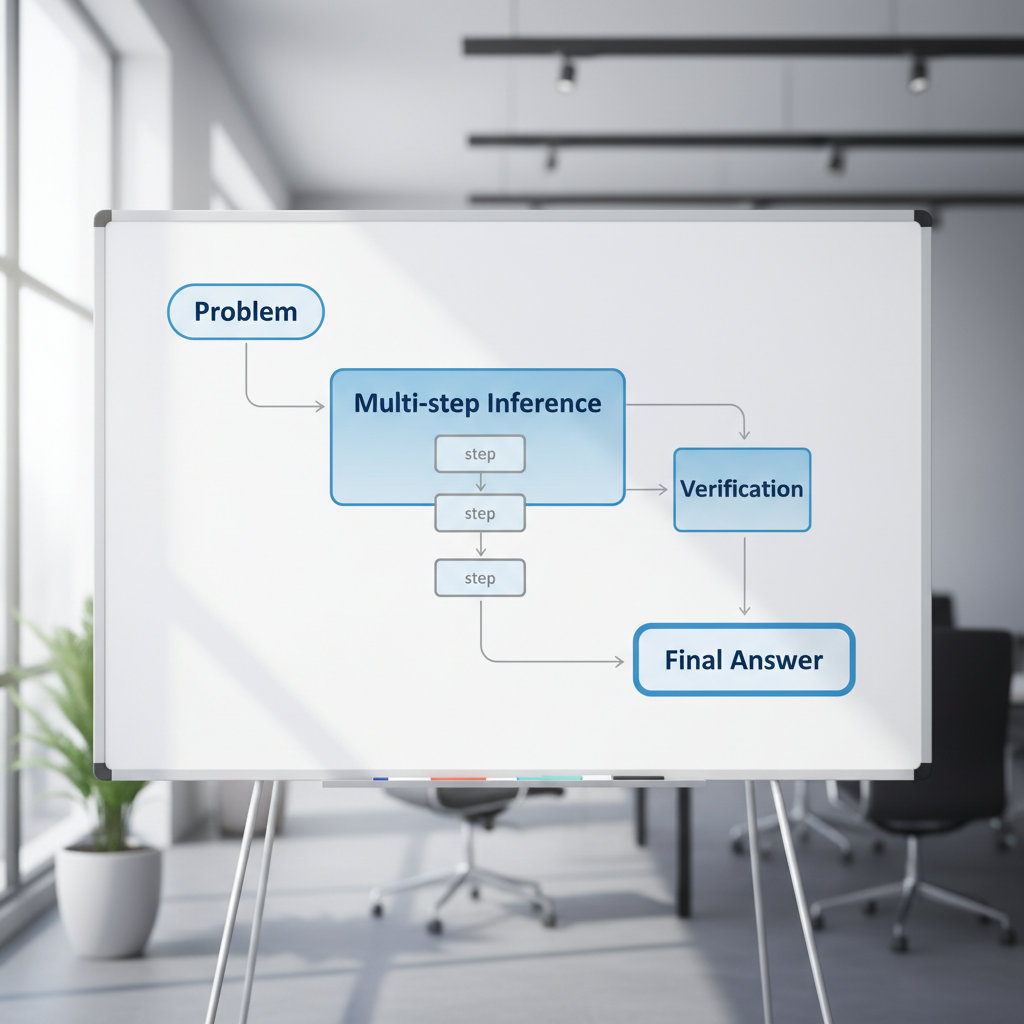
What “AI Reasoning” actually covers (and what it doesn’t)
In product conversations, AI Reasoning can mean anything from “the model explains itself” to “it solved a logic puzzle.” In real systems, it’s more useful to define it by behaviors: can the model keep track of constraints, do multi-step inference without drifting, and arrive at answers that remain stable when you probe them.
What it usually includes is logical reasoning models that can handle structured problems, like selecting items under constraints, planning steps, or reconciling conflicting requirements. What it does not guarantee is truth, perfect math, or safe decisions, especially when the model lacks reliable tools or verified context.
According to NIST, trustworthy AI involves characteristics like validity, reliability, safety, and transparency, which is a helpful reminder that “reasoning” is not one feature, it’s a bundle of qualities you have to measure and maintain.
Why models fail at multi-step inference in everyday scenarios
Most breakdowns look like “small” issues until you realize they compound across steps. A model might misread a constraint early, then build a neat-sounding answer on a shaky base. This is why step-by-step AI problem solving can look correct while still being wrong.
Common root causes you’ll see in production:
- Constraint loss: the model forgets or quietly relaxes a requirement halfway through.
- Ambiguity collapse: instead of asking a clarifying question, it picks an interpretation and runs.
- Hidden assumptions: it fills in missing facts, then treats them as confirmed.
- Tool mismatch: the task needs a calculator, database, or policy engine, but the model “guesses” anyway.
- Evaluation mismatch: you measured style and helpfulness, but not reasoning stability under follow-ups.
Many teams also run into a practical tension: the more you push for explanations, the easier it is for the system to produce plausible narratives that do not reflect the true internal path to the answer.

Chain-of-thought reasoning vs. structured reasoning: how to choose
Chain-of-thought reasoning (CoT) is often used as shorthand for “the model thinks in steps.” In practice, CoT is a prompting and training pattern that can improve multi-step inference, especially on tasks that require intermediate transformations.
But structured problem solving AI often works better when you can make the structure explicit: tables, schemas, checklists, intermediate state, tool calls, and validation gates. If you can represent the problem in a constrained format, you reduce the room for the model to improvise.
Quick decision rule
- Use CoT-style prompting when the task is fuzzy, exploratory, and you need the model to surface intermediate reasoning for debugging.
- Use structured approaches when you can define rules, constraints, or intermediate outputs that can be checked.
- Use both when you want the model to propose steps, then force those steps through a verifier or tool layer.
One important nuance: you can often get the benefits of “step-by-step” without exposing verbose internal reasoning to the end user, which helps when explanations might leak sensitive logic or confuse customers.
Reasoning-augmented AI: patterns that hold up in production
Reasoning-augmented AI usually means the model is not reasoning in isolation. It’s supported by scaffolding: retrieval, tools, guardrails, and post-checks. This is where advanced AI inference becomes less about a single prompt and more about a system design.
Patterns that teams reach for repeatedly:
- Plan-then-execute: generate a short plan, then run steps with tool calls and checkpoints.
- Decompose-and-verify: split the question into sub-questions, verify each with sources or rules.
- Self-consistency sampling: run multiple solution paths and pick the most consistent outcome (useful, but watch cost).
- RAG with citations: ground answers in retrieved documents, then require citation coverage for key claims.
- Policy + model: let deterministic logic handle “must/never” constraints, while the model handles language and edge cases.
According to OpenAI, evaluation and iterative deployment practices matter for improving model behavior over time, and in reasoning-heavy workflows that usually translates to “tight feedback loops plus targeted tests,” not just bigger prompts.
A practical self-check: do you have a reasoning problem or a data problem?
A lot of “reasoning bugs” are actually missing context, unclear objectives, or untestable requirements. Before you redesign prompts, it helps to classify the failure.
- Likely a context/data issue if answers improve dramatically when you paste more relevant facts, examples, or policies.
- Likely a reasoning issue if the model has the facts but still violates constraints, mixes steps, or contradicts itself under follow-up questions.
- Likely a product spec issue if humans also disagree on the “right” answer, or the acceptance criteria is vague.
When you’re evaluating LLM reasoning capabilities, try a simple “pressure test”: ask the same task with one constraint swapped, then see whether the output changes in the exact place it should. If it changes everywhere, you’re looking at instability, not intelligence.
Reasoning benchmarks for AI: what to measure (and what to ignore)
Benchmarks can be useful, but only if they match your real workload. A high score on a popular suite might not predict success in your customer support flow or internal compliance assistant. Reasoning benchmarks for AI should be treated like a lab instrument, not a guarantee.
Here’s a table teams often use to align tests with business risk:
| What you test | Why it matters | How to implement quickly |
|---|---|---|
| Constraint adherence | Prevents “helpful” answers that break rules | Create prompts with explicit must/must-not checks, auto-grade violations |
| Multi-step inference stability | Reduces drift across steps and follow-ups | Run variants with one condition changed, compare diff location |
| Grounding / citation coverage | Stops unsupported claims in high-stakes areas | Require citations for key statements, flag missing sources |
| Tool-use correctness | Avoids guessing when a tool is available | Log tool calls, check inputs/outputs, add “no tool, no answer” gates |
| Calibration (confidence vs. accuracy) | Controls overconfident wrong answers | Collect “uncertain” triggers, measure refusal/ask-clarify rates |
According to Stanford HAI, evaluations should reflect real-world contexts and impacts, which is another way of saying: if your benchmark never includes your messy constraints, it won’t protect you from them.

Implementation playbook: improving reasoning without overengineering
If you want better AI Reasoning outcomes this quarter, the win usually comes from a few disciplined moves, not a total rebuild. This is the part many teams skip because it feels “less exciting,” but it’s where reliability comes from.
Step-by-step changes that tend to pay off
- Rewrite tasks as constraints: convert “make it good” into testable rules, examples, and non-examples.
- Force intermediate outputs: ask for a plan, a list of assumptions, or a structured table before the final answer.
- Add verification gates: run a lightweight checker that flags policy violations, missing citations, or math errors.
- Introduce “ask a question” paths: reward clarifying questions when inputs are underspecified.
- Log reasoning signals: track constraint failures and correction rate, not just thumbs-up/down.
Key takeaways to keep on one screen
- Reasoning improves when structure increases, even if the model stays the same.
- Explanations are not proof; validation beats verbosity.
- Benchmarks should mirror your risks, not internet trivia.
If your use case touches legal, medical, or safety decisions, treat outputs as advisory, add human review, and consider asking a qualified professional to define what “acceptable reasoning” means for that domain.
Conclusion: aim for dependable reasoning, not magical thinking
AI Reasoning gets noticeably better when you stop expecting a single prompt to do everything and start treating reasoning as a workflow: clarify constraints, structure the steps, verify the outcome, then measure the same failure modes every week.
If you want a simple next move, pick one high-value task, write ten adversarial test cases, and add one verification gate. You’ll learn more from that than from another round of prompt tweaking that never gets evaluated.